
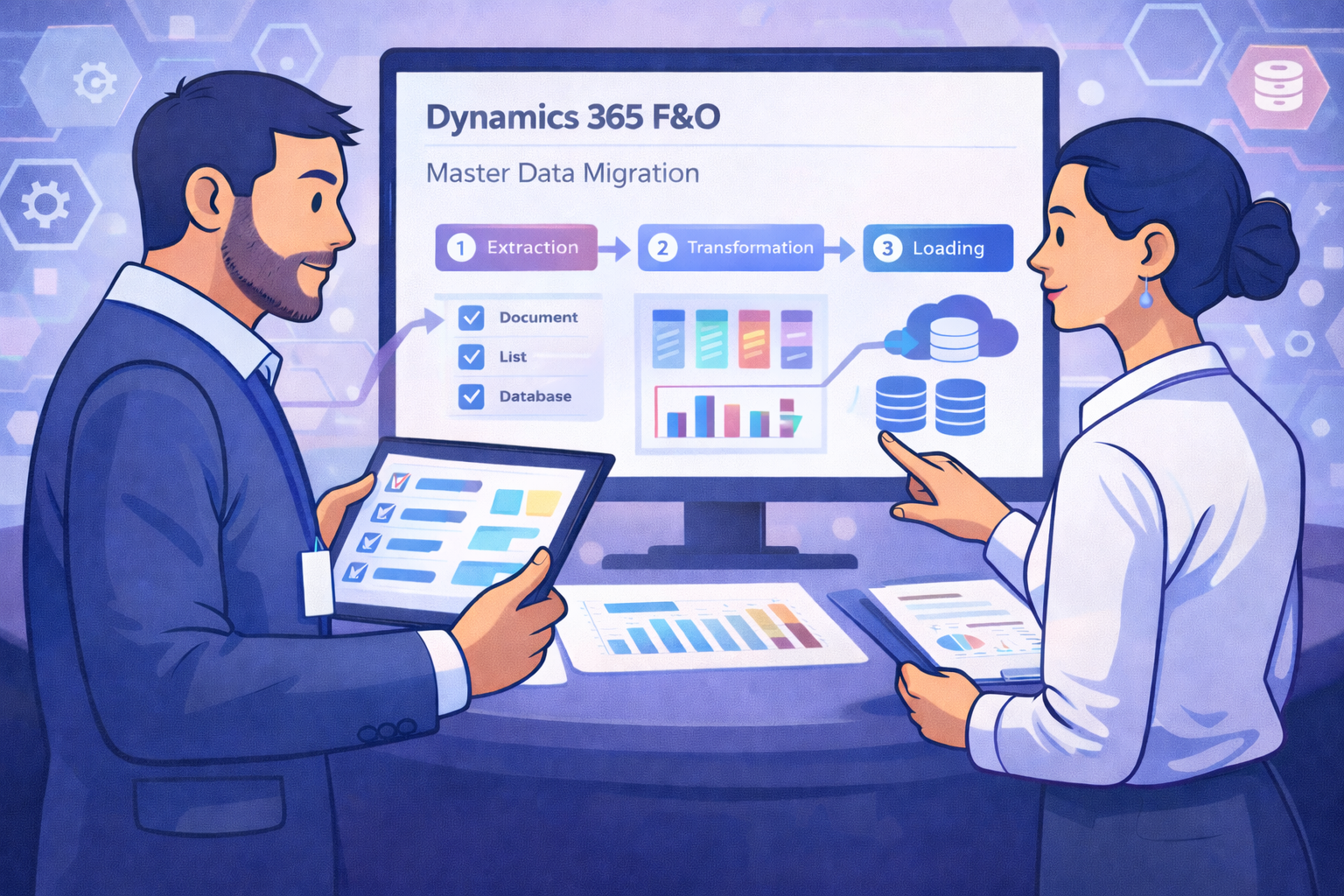
Master Data migration in Dynamics 365 F&O – a practical guide
Have you ever wondered why Master Data migration is considered one of the most critical stages of implementing an enterprise-class ERP system like Microsoft Dynamics 365 Finance & Operations (D365 F&O)? Master Data forms the foundation upon which all subsequent transactions and business processes are built: from sales and purchasing to production and finance.
This article is a continuation of the publication “Migration from AX 2012 to Dynamics 365. How to do it successfully?” and serves as a practical guide for the effective transfer of key information assets.
The importance of Master Data for Business continuity in D365 F&O
Master data affects nearly every process within Dynamics 365 Finance & Operations, including sales, purchasing, warehouse management, production, and finance. Incorrect migration of this data can lead to serious operational issues, such as:
Inaccurate inventory levels.
Incorrect invoices and price lists.
Errors in reporting or integrations with other systems.
Practical example: A product in the source system has different units of measure for purchase and sale. A lack of correctly defined unit conversions in D365 F&O will result in incorrect stock levels and erroneous order values. wartości zamówień.
Strategic migration order: How to maintain integrity?
The D365 F&O system relies on a dense network of dependencies between entities. This means a specific record cannot be loaded successfully if the records it references do not already exist.
The recommended migration sequence is as follows:
Legal entities: The foundation for the chart of accounts, customers, vendors, and products.
Main accounts (Chart of Accounts): Defines the accounting links for customers, vendors, and products.
Financial dimensions: Used in postings and reporting.
Customers: Require existing legal entities, main accounts, and dimensions.
Vendors: Similar dependencies as customers.
Products / Released products: Require units of measure, categories, and assignment to a legal entity.
Warehouses and locations: Linked to products and legal entities.
Trade agreements (price lists): Can be loaded after customers, vendors, and products.
Security roles: Linked to legal entities and business processes.
Practical example: You must first migrate legal entities and the chart of accounts. Only then can you add a customer with an assigned financial dimension and price group. Attempting to migrate in reverse order will cause the customer record to be rejected.
Key principles for secure data migration
To ensure a smooth Master Data migration in D365, follow these fundamental rules:
- Phased migration: Execute the migration according to the logical sequence of dependencies between data entities.
- Testing in a staging environment: Every batch of data should be verified before being written to the production environment.
- Link validation: Every product, customer, and vendor must have correct ledger accounts, legal entities, and financial dimensions.
- Data cleansing: Remove duplicates and standardize units of measure, categories, and data formats.
- Populating data between companies: In multi-company organizations, it is beneficial to use the standard Cross-company data sharing mechanism. This allows for the sharing of selected data (e.g., financial dimensions or products) without duplicating them.
In more complex scenarios where maintaining a full history of changes and specific links is required, it is recommended to use professional external tools such as YDM (Yavica Data Management).
Practical example: The CustomerV3 entity requires the Customer Group field to be filled. Missing this value will prevent the customer from being used in price lists and orders. In multi-company environments, both Cross Data Sharing and YDM-type tools can help ensure the consistency of this data.
The role of financial dimensions in the data structure
Financial dimensions enable the analysis of operations across various segments, such as department, project, location, or cost center. They are critical for the following reasons:
- They are linked to main accounts, customers, and products.
- A lack of or incorrect configuration prevents posting and reporting.
Practical examples:
- A customer with an assigned “Department – Sales” dimension will not be saved if that dimension value does not exist in the DimensionAttributeValueCombinationEntity.
- A product using dimensions in costs or revenues must have active dimensions before migration.
- In projects and production orders, the “Project” dimension must be correctly linked to the legal entity and chart of accounts.
Principles of dimension migration:
- Load dimension values first, then the records that use them.
- Verify dimension combinations to avoid posting errors.
- Validate data at every test stage of the migration.
Practical tips for specialists: Handling variants, price lists, and DMF tools
Effective Master Data migration in D365 requires attention to technical details that have a direct impact on later logistics and sales. For products with multiple attributes, such as color or size, each specific variant must be entered as a separate record in the Released ProductV2 entity. Equally important is the verification of counterparty data – before importing customers and vendors, you must ensure that assigned price groups, payment terms, and links to financial dimensions are complete and correct.
In the area of price management, Trade Agreements should be entered with a strictly defined effective date. This avoids conflicts with historical data and ensures the correctness of price calculations in current transactions. The entire technical process should be carried out in stages using the DMF (Data Management Framework) tool. A key practice is the regular analysis of DMF logs – it sometimes happens that records successfully pass the staging phase but are rejected during the final write to production tables due to business validation errors.
Tip: Phased migration significantly reduces the number of errors and facilitates the identification of problematic records.
Common migration errors and how to avoid them
The most serious strategic error is attempting to migrate “everything at once”. The lack of a phased approach prevents the rapid identification of errors and often leads to the necessity of cleaning the entire database. A very common problem is also the absence of financial dimensions or their incorrect connection with ledger accounts, which in practice blocks the ability to perform any postings in the system.
In the area of product data, a critical oversight is importing Released Products without defined units of measure or categories. A lack of verification of unit conversions is a direct path to significant discrepancies in inventory levels. A similar risk applies to counterparties – omitting a required price group or a lack of a payment term makes customer and vendor records useless in operational processes.
Practical example: Migrating products without verifying unit of measure conversions can lead to significant discrepancies in inventory levels.
Key D365 F&O terminology
Understanding the mapping of concepts between Polish and English is essential for the correct use of technical documentation and data entities:
- Legal Entity: The foundation of the system, migrated first as it serves as the base for all other data.
- Main Account: A financial structure strictly linked to the legal entity and dimensions.
- Financial Dimension: An analytical element that must exist in the system before being assigned to specific records.
- Customer / Vendor: Records requiring special attention regarding price groups, payment methods, and bank accounts.
- Product / Released Product: During product migration, units of measure and categories are mandatory; each variant is treated as a separate record.
- Warehouse: An entity requiring verification of receipt and issue rules for goods.
- Unit of Measure / Trade Agreement: Key for logistics and sales; require correct conversions and effective dates.
- Security Roles: Permissions linked directly to legal entities and processes.
Summary
Effective Master Data migration in D365 in Dynamics 365 Finance & Operations is a process requiring precise planning and rigorous testing. The key to success is accurate data mapping between the legacy system and D365 F&O, along with link validation at every stage of testing. It is important to remember the correct configuration of financial dimensions and to account for specific business scenarios, such as product variants or complex price groups.
A good practice that minimizes the risk of operational errors is creating migration templates with clear entity descriptions and involving business users in the data validation process. Depending on the complexity of the project, tools should be chosen consciously – from the standard Cross-company data sharing mechanism to advanced external solutions such as YDM (Yavica Data Management).
If you are not sure whether you fully understand all of this, contact us to discuss it.

Tomasz Kempf
D365 Functional Consultant I Data Migration Specialist